Chapter 10 of the Sprint DGX series. What we built in 60 days with NVIDIA Innovation Lab, and why we decided it should live in the clinic, not in the cloud.
The mouth is one of the best places in the body to catch things that matter in time. A lesion that’s changing, a pattern that doesn’t fit, a detail worth a second look. The bottleneck is almost never a lack of information, a clinic generates radiographs, records, and notes every day, but the lack of an extra pair of eyes, tireless and consistent, that helps the professional miss nothing.
That’s what we built at QuantumHowl. And this past quarter we took the biggest leap yet: we trained the vision brain of our dental product on a node of eight NVIDIA H100 GPUs, thanks to a 60-day grant from the NVIDIA Innovation Lab program.
On a public dental-knowledge exam, our specialized model lands ahead of generalist models that are far larger and more expensive.
What we built
A vision-language model specialized in dentistry, starting from Gemma 4 31B, one of the most capable open models in its size class, and fine-tuned on our own clinical data. It’s not a chatbot you slap a photo onto: it’s a model that looks at the image and reasons about it in the same step.
The first serious decision was choosing the right base. Before investing a single day of training, we benchmarked candidates on real dental clinical questions. Gemma 4 beat the alternative we’d started with by more than 25 percentage points, with statistical significance. Switching horses in time, with the data in hand, saved us the entire sprint.
What it can do
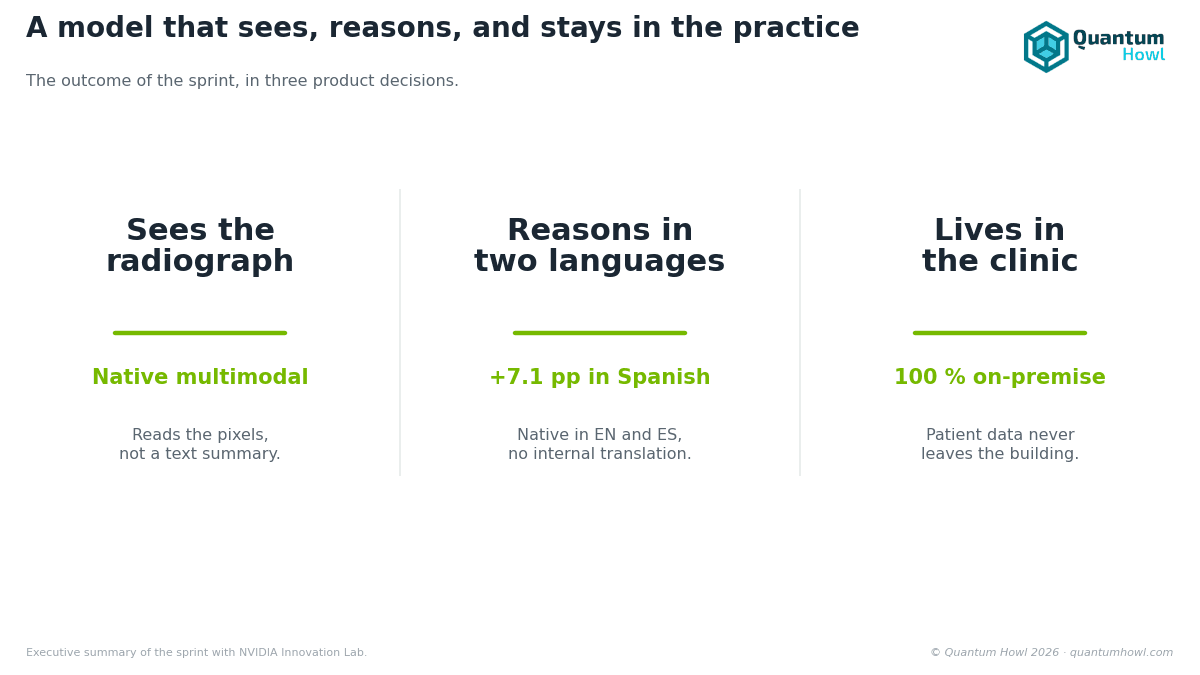
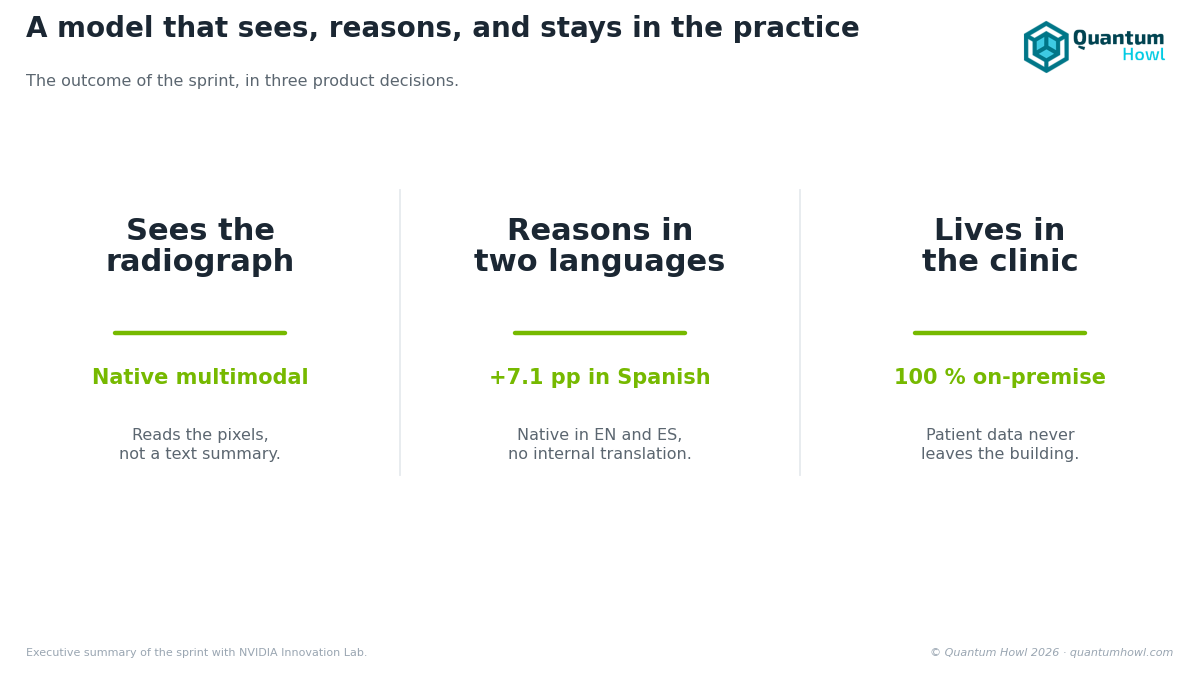
- It sees the radiograph. Panoramics, periapicals, intraoral photos. The model interprets the image directly, not a description of the image produced by some other system.
- It reasons in Spanish and English, equally. We verified it with our own purpose-built tests: the quality in Spanish isn’t a second-rate “translation mode”, it’s genuine parity. For a Spanish-speaking clinical market, that’s no detail.
- Measurable improvement. After specialization, the model gains +6.72 percentage points in English and +7.13 in Spanish on a public dental-knowledge exam (MMOral-Bench), a highly competitive result for its size class.
- It responds in real time. Fast enough to assist the professional during the consultation, not to keep them waiting.
Why we decided it should live in the clinic, not in the cloud
This, for us, is the part that truly sets the product apart. The model is designed and validated to run on-premise, inside the clinic, on an NVIDIA DGX Spark, NVIDIA’s desktop AI computer, with 128 GB of unified memory, as the minimum configuration, and up from there. What does that mean in practice?
That not a single patient image leaves the building. There’s no health data traveling to a third-party server, no dependence on a connection, no cloud provider sitting in the middle of the conversation between the dentist and their information. In a sector where the data is especially sensitive, and the regulation especially demanding, “it stays home” isn’t a technical concession: it’s an advantage from the outset.
This is not a demo
The product this layer will plug into is already in production at a real clinic, serving several thousand patients and managing hundreds of thousands of images, reliably. The sprint didn’t build a prototype to show off in a video: it trained the hardest layer, the intelligence layer, of a system that already works, so that what the professional already uses every day is, simply, better.
Where it’s headed
The goal hasn’t changed since day one: to put in the professional’s hands an aid that sees what matters, sooner and better, without asking them to give up control of their data or their practice. What we achieved in these 60 days, a model that sees, reasons in two languages, and is designed to live on-premise, is the foundation. The next step is bringing it to more clinics.
If you work in a dental group, invest in digital health, or are simply curious about how to build clinical AI that genuinely respects privacy, we’d love to show you.
What hardware will it run on? The deployment target is an NVIDIA DGX Spark, 128 GB of unified memory, as a minimum, and any more powerful machine. Plenty of memory to load the full model, and deployment on Spark has already been validated: data-center-class power in a box that fits in the practice, not in a remote data center.
Is it available? The base system is in production. The integration of this new vision layer is rolling out in phases; we’re open to conversations with clinics and partners.
Next chapter: why «reading an X-ray» is not the same as describing it in text and reasoning over that description, and why that difference matters.