Chapter 8 of the Sprint DGX series. The most important product decision wasn’t which model to train, but where to let it run: inside the practice, on the dentist’s desktop, without a single piece of patient data ever crossing the door. (from Chapter 1).
There’s a detail that almost no one asks about during a slick demo and that, in a real clinic, is the very first thing: where does my patient’s X-ray end up? The most convenient answer to build is “in someone’s cloud.” Ours is the opposite, and we chose it on purpose. The vision brain we trained over these 60 days is designed to run on-premise, inside the building, on an NVIDIA DGX Spark that fits at the front desk. This chapter is about why that decision, far from being a technical concession, is the product’s starting advantage.
The patient’s data never leaves the building
When a dental AI works against the cloud, every image the dentist wants to analyze sets off on a journey: it leaves the practice, crosses the internet, reaches a third party’s server, gets processed there, and comes back. Along that route there are health records circulating outside the control of whoever generated them, a dependency on the connection, and an external provider inserted into the middle of the conversation between the professional and their patient’s information.
We cut that journey off at the root, by design. The model is built to run in the clinic itself, on hardware that belongs to the clinic. That way, not a single patient image needs to leave the building. There’s no remote server, no transit of health data over the network, no intermediary cloud. The X-ray comes in, the model interprets it right there, and the answer never has to leave.
In a sector where the data is among the most sensitive that exists, clinical records, medical images, patient identity, and where the regulation is among the most demanding, “it stays home” stops being a slogan. It’s the cleanest way to comply with GDPR: what never moves can’t be intercepted, can’t be leaked on someone else’s server, and doesn’t depend on the retention policy of a provider you don’t control. Privacy isn’t promised: it’s guaranteed by architecture.
Data-center power in a box that fits in the practice
For years, “powerful model” and “has to live in the cloud” were almost synonymous: large models demanded data-center hardware, and that meant renting remote GPUs by the hour. The NVIDIA DGX Spark breaks that equation. It’s a desktop AI computer, the size of a desktop machine, with 128 GB of unified memory built on Grace-Blackwell architecture. Data-center-class power, in a box that fits on a piece of furniture in the practice.
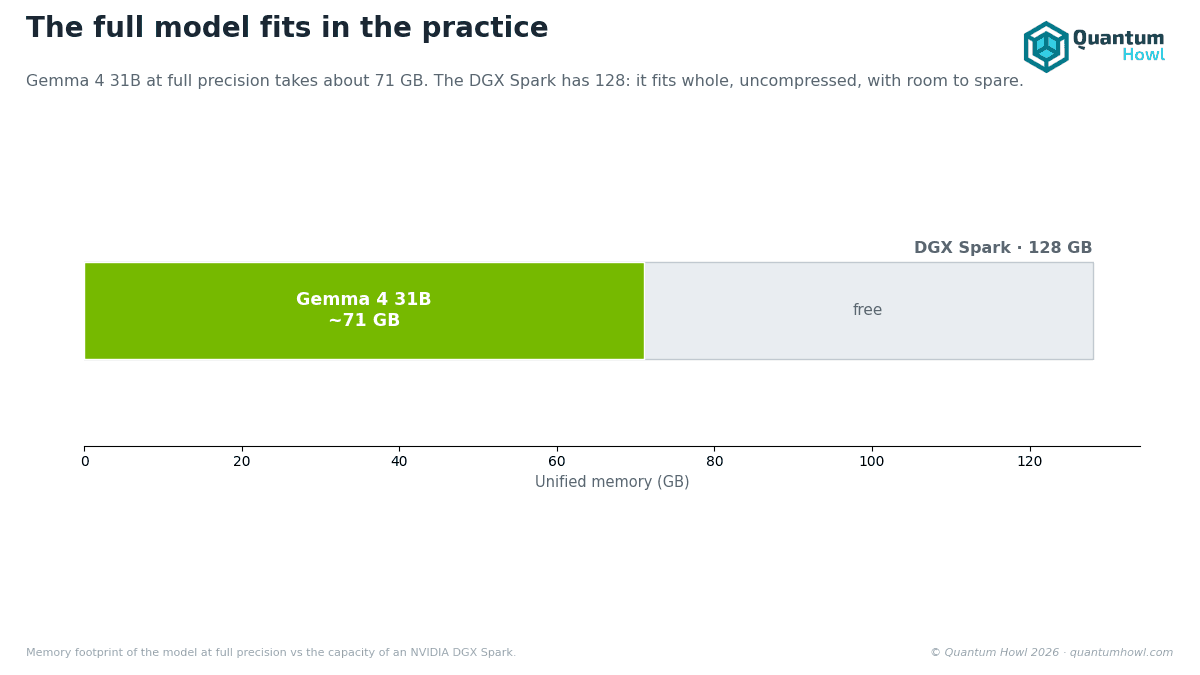
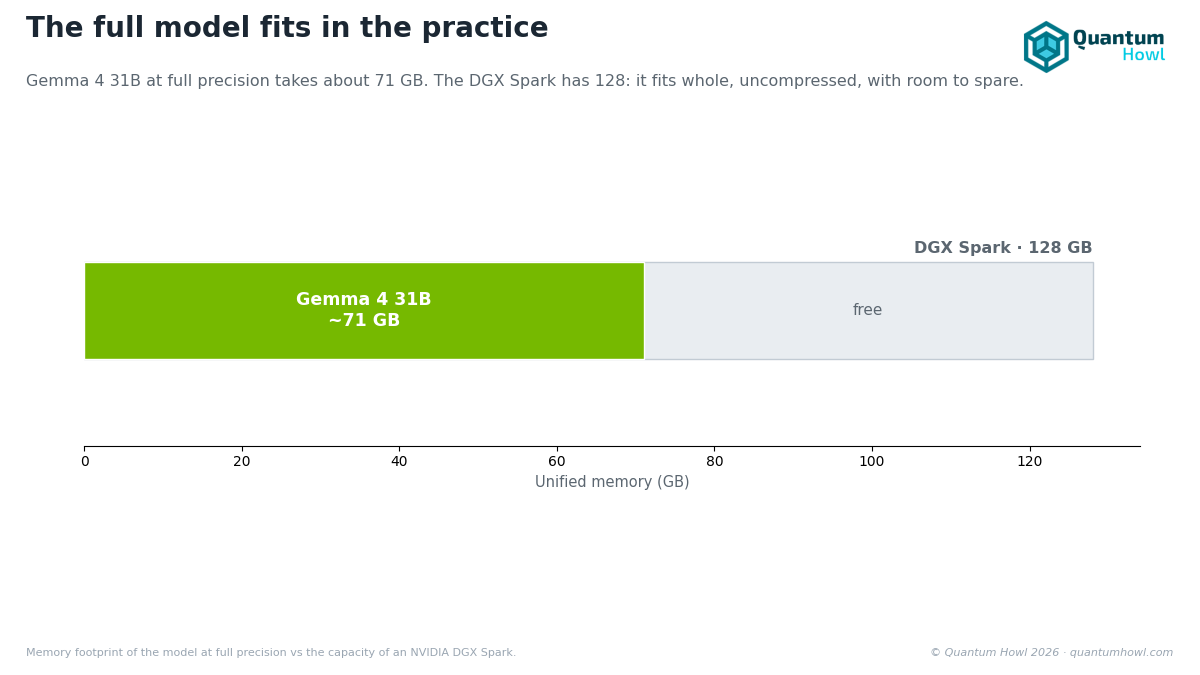
And here’s what matters to us: the full model, Gemma 4 31B, fits without trimming a single bit of precision. The entire model, weights, vision tower, and working memory, comes to around 71 GB, comfortably inside the Spark’s 128 GB. We don’t have to compress the model, or degrade it, or serve a “lightweight” version that performs worse just to squeeze it into a small machine. On the Spark it runs exactly the same vision brain we validated on the H100s, at full precision, with enough latency to interpret an X-ray in a matter of seconds while the professional keeps working with the patient right in front of them.
This is what changes the conversation. On-premise privacy stopped costing performance. You no longer have to choose between “powerful but in the cloud” and “private but weak”: the Spark delivers both at once.
One clinic, one box, zero external dependencies
The planned deployment is, deliberately, simple. Each clinic will run its own instance of Dental Brain on its own DGX Spark. There’s no cloud account to renew, no usage bill that grows with every X-ray analyzed, no external service that can go down, change its price, or shut down and leave the practice without its tool from one day to the next.
There’s no dependency on the connection either. If the internet goes down, and in a clinic that happens, the AI keeps working, because it never needed to go out and fetch anything. The professional turns on their machine in the morning and the vision brain is there, just like the chair or the lamp. It’s clinic infrastructure, not a service the clinic rents.
For a dental group, this translates into a very concrete property: control. Control over where the data is, over when the system updates, over the cost, a hardware purchase, not an open-ended subscription, and over service continuity. The product lives in their hands, not in a third party’s.
The advantage, not the concession
It’s tempting to present on-premise as a sacrifice: “we give up the convenience of the cloud in order to comply with regulation.” We see it exactly the other way around. In a market as sensitive about data as healthcare, running inside the practice is what makes the product sellable.
A leader of a dental group who hears “your X-rays never leave your building” doesn’t hear a limitation: they hear that the thorniest problem of adopting AI in healthcare, privacy and compliance, is already solved from the outset, by design and not by contract. The uncomfortable question from the demo stops being a risk and becomes our best argument. Where others have to explain what they do with the patient’s data in their cloud, we answer that we do nothing with it, because we don’t have it: it’s where it always was, in the clinic.
That’s the difference between building clinical AI that tolerates privacy and building clinical AI designed around it.
The Spark is the floor, not the ceiling
The 128 GB DGX Spark is our minimum configuration: the entry point that already runs the full model at full precision. From there up, everything fits. A group with more volume, several sites, or a need for more simultaneous performance can step up to higher DGX-class hardware, higher-end NVIDIA stations and servers, without changing models or philosophy: the same vision brain, the same guarantee that the data doesn’t leave, more capacity when it’s needed.
That the minimum is already a machine capable of loading the entire model without cuts is precisely what makes the proposition credible. We’re not selling an amputated version that one day aspires to the “real one” in the cloud. We’re selling the full model, from the first box, with the ceiling open to grow.
Where this leaves us
We built a dental vision brain that sees the X-ray, reasons in two languages, and ranks among the best in its size class. And we decided it should live where it truly belongs: in the clinic, on a DGX Spark, with the patient’s data shielded by the very architecture of the system. What’s next is bringing that box to more practices. If you work at a dental group, invest in digital health, or are simply interested in how clinical AI that genuinely respects privacy gets built, this is the part we like to show in person.
FAQ
Does this mean my data never goes to the cloud? Exactly. By design, the model runs inside the clinic, on the practice’s own DGX Spark. X-rays, records, and patient images are processed right there and never leave the building at any point. There’s no remote server or external provider in the middle: it’s the most direct way to comply with GDPR, because what doesn’t move can’t be intercepted or leaked.
Isn’t the DGX Spark too small for a 31B model? Quite the opposite. Its 128 GB of unified memory load the full model, Gemma 4 31B, at full precision, without compressing or degrading anything, the whole thing comes to around 71 GB, with plenty of room to spare. It’s data-center-class power in a desktop form factor, enough to interpret an X-ray in seconds during the visit itself.
And if a clinic needs more power than a single Spark provides? The 128 GB Spark is the minimum configuration, not the limit. From there it scales up to higher DGX-class hardware for groups with more volume or more sites, keeping the same model, the same target latency, and the same guarantee that the patient’s data never leaves the building.