Chapter 11 of the Sprint DGX series. What it really means for a model to be multimodal, and why reasoning natively in Spanish is no afterthought.
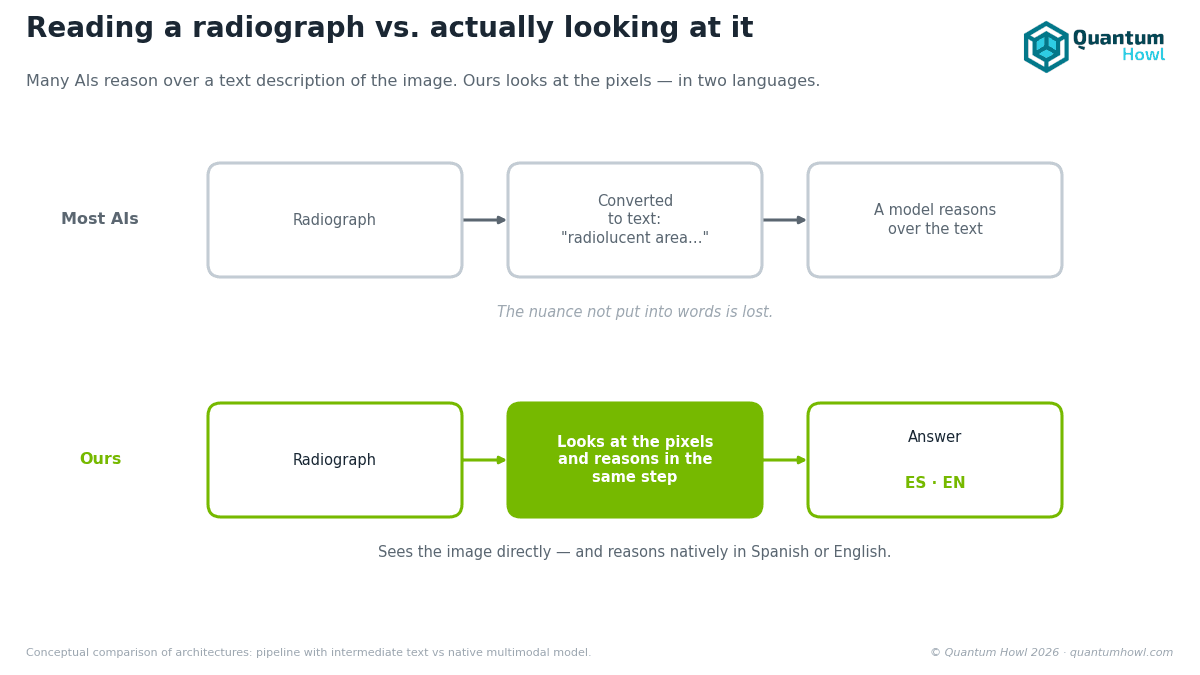
There’s a small trick worth knowing before you trust any “AI that analyzes X-rays.” Many of them, under the hood, never look at the image at all: one system describes it in text, “a radiolucent area is observed in the lower right quadrant”, and a language model reasons over that description. It works… until the detail that matters is exactly the one the middleman couldn’t put into words.
The dental vision model we trained this quarter doesn’t work that way: it looks at the X-ray’s pixels directly, in the same step where it reasons. And it does so just as fluently in Spanish as in English, which, believe us, is rarer than it sounds.
Looking at the image, not its summary
“Truly multimodal” means the model takes in the image and the text together and understands them in the same space, with no translator in between turning the X-ray into a sentence. The difference isn’t academic. A subtle edge on a lesion, an asymmetry, a texture that doesn’t add up: these are exactly the kind of signal a text intermediary never manages to verbalize, and that a model which genuinely looks can actually take into account.
In the clinic, that’s the difference between a tool that helps you not miss anything and one that just repeats back to you, in different words, what was already decided a step earlier.
How you teach it to see teeth
It isn’t a single training run, but several layers built one on top of another. First, clinical vocabulary: the model genuinely knowing what an interproximal cavity, a crown, or a resorption is. Then, tying those concepts to what shows up in the image. And finally, solving complete clinical tasks: look at an X-ray and answer. Each stage supports the next.
The result, measured against a public dental-knowledge exam, is clear: the specialized model improves markedly over the starting model and lands among the best in its size class.
Reasoning in your language isn’t the same as translating
Plenty of models “speak Spanish,” but internally they translate your question into English, reason in English, and translate the answer back. Nuance gets lost along the way, and sometimes accuracy too.
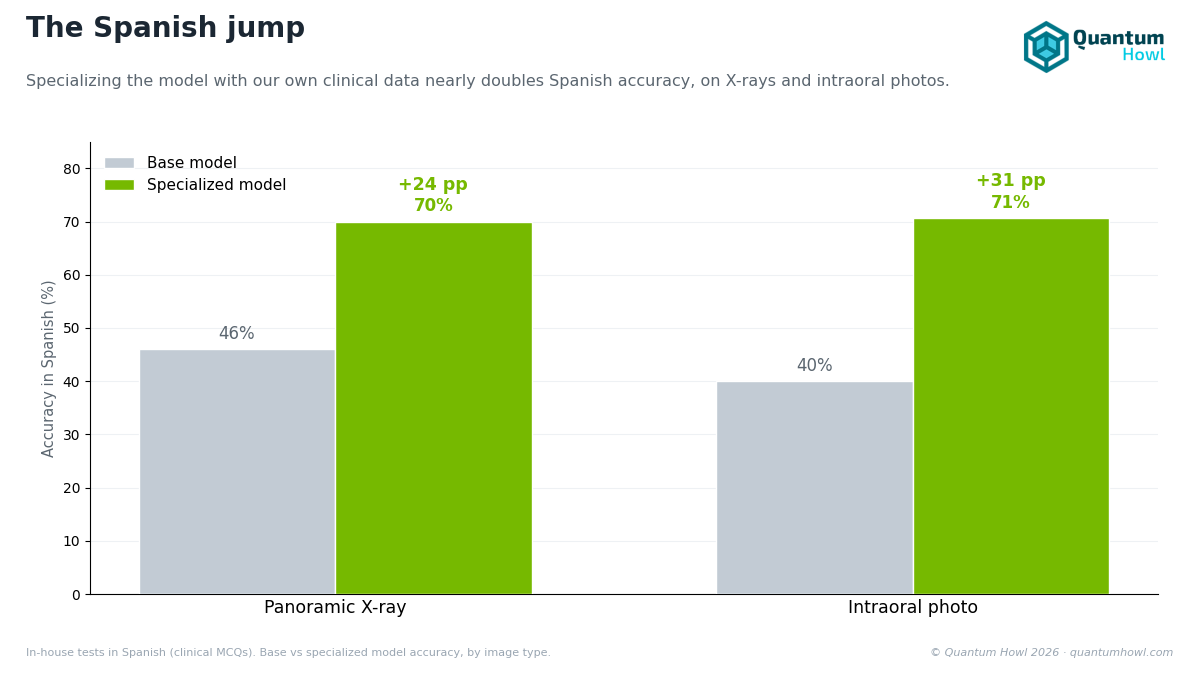
We wanted to make sure ours reasons natively in both languages, not secondhand. So we built our own tests, with equivalent clinical questions in Spanish and English, and measured whether quality dropped when switching languages. It didn’t: genuine parity. And the specialized model’s jump over the base model, in Spanish, was large: +7.13 percentage points on the public dental-knowledge exam.
For a clinic that works in Spanish, “it works just as well in my language” isn’t a nice-to-have. It’s the precondition for trusting it.
Why we built it this way
In the practice, “genuinely seeing” and “genuinely understanding in your language” aren’t technical luxuries: they’re the line that separates a tool you lean on from one you have to keep double-checking. That’s why we built it this way, and why we measured it instead of assuming it.
What image types does it understand? Panoramic, periapical, and intraoral photographs.
Does it really reason natively in Spanish? Yes, and we verified it with our own tests: quality doesn’t drop relative to English.
Do I have to send the images to the cloud? No: it’s designed to run inside the clinic, on an NVIDIA DGX Spark, so that not a single image leaves the building.
Next chapter: we didn’t start from zero. How this model is trained to fit into a dental product already in production, not into a demo.